Interview with Steffen Kummerer of Obscura

Last Wednesday we had the chance to witness Obscura playing a good chunk of their new album A Sonication, which was released at the beginning of the month. What separates Obscura from the rest of Tech Death Metal bands is the sound consistence and the pure calculating knowledge the band pours into each of their 8th records. This time around the quick 39-minute opus would get you headbanging from beginning to end. That is not something that I personally say, but it was ratified by the crowd of Prague’s metalhead community that gathered at Futurum on a weekday night to listen to sophisticated, and pure high quality death metal.
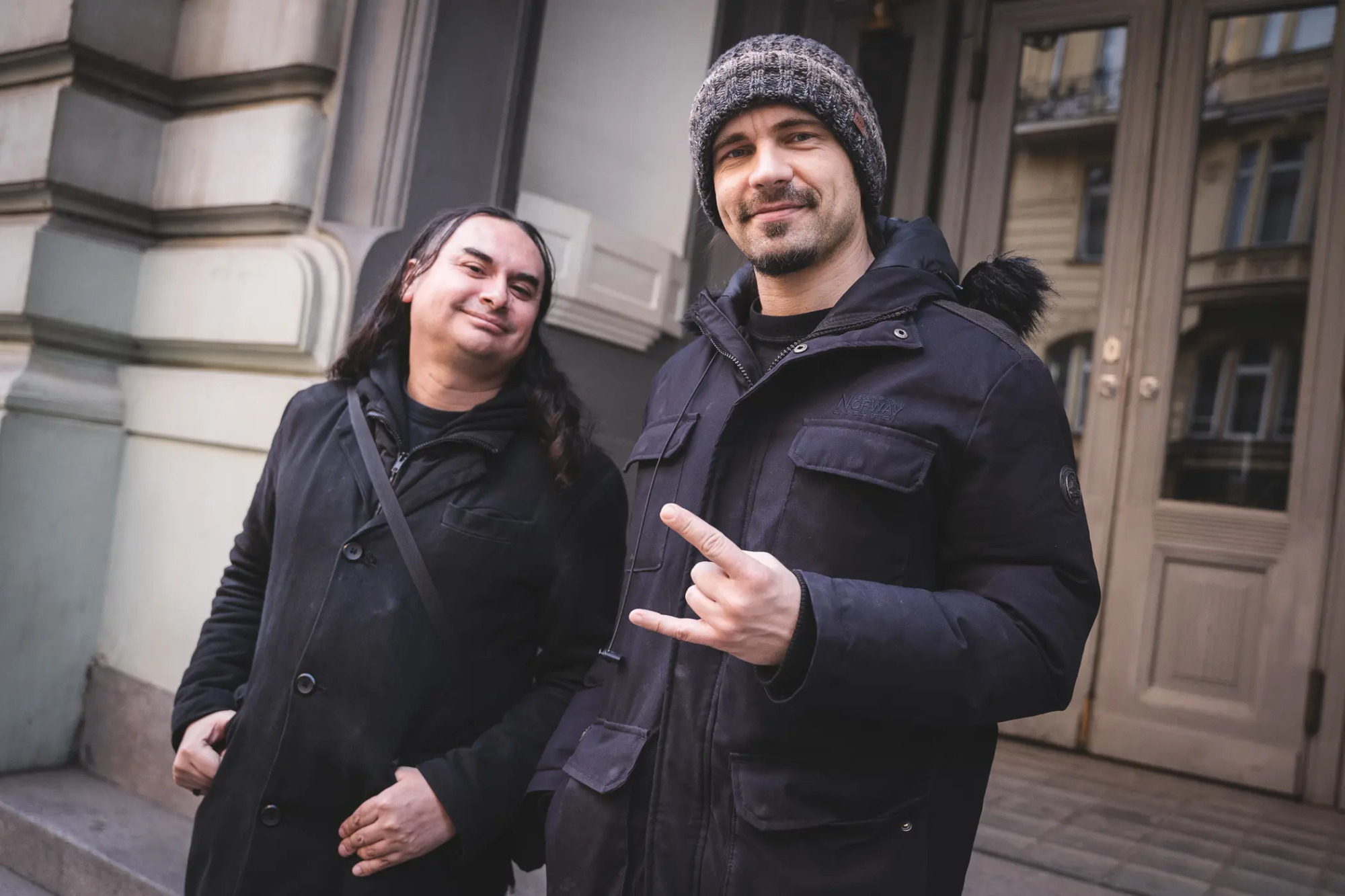
Before the show we had the chance to speak with Obscura’s Steffen Kummerer and discussed the new album, the tour, logistics and a bit of gear-talk
Miguel (Metal Heart Radio): Hello Steffen, thank you for taking the time to talk to us, alright, these are the last two dates left on the tour. How has been the experience of the new songs from A Sonication
Steffen Kummerer: Well, to be honest, a few of the new songs work live way better than on the record.
MHR: Really?
SK: Yeah, especially, Silver Linings, Evenfall, and The Sun Eater is ridiculously cool, you never know when you put out a new record, you don't know how people receive the songs in a live situation, so far this is really, really cool. We play four or five songs of the new record every evening, the focus is always on the new album, and that works super well, to be honest.
MHR: What is your favorite song to play from the new album?
SK: I would say Silver Linings, because there is so much going on, it's a back and forth between both guitarists, also in a live setting, so it's more like a lead solo duel every now and then, and it's a lot of interaction on stage, so it's not only like a band that plays their stuff, but it's more like a back and forth, and it's really cool and it turns out to work quite well.
MHR: This is the second part of the trilogy concept. How are these themes from the A Valediction connect to the new album?
SK: Well, if you think in colors. The first one, A Valediction, was the bronze one, this is the silver one, next one will be gold. In A Valediction was dealing with farewells, goodbyes, like, you know, ending a chapter. This one is more the reflective one, so it's a little bit more introverted, melancholic at times, and the next one we will see. So that's how I put it together.
MHR; Is there already some work done towards that new chapter in some way?
SK: No, at the moment we just released a new album. We focus on that, of course I'm collecting ideas for lyrics, for artworks, for music every time, but I'm not starting to write music yet. That's too early.
MHR: the one thing that surprised me about this album was definitely that the album is 39 minutes long, It's really short. You can listen to it on its entirely in your car on your way to work if you have a 40-minute commute, why make an album so short?
SK: To be honest, on A Valediction we had 11 songs, and I got the impression that the last third of the album did not get the recognition it deserves. So, all the songs are good, but we figured that the songs on the very end haven't been listened that much, so maybe it was more interesting to have an album that says everything that needs to be said without fillers. That was the whole idea behind it, so last time was a little bit too much, maybe this is too short.
So, let's make the next album with 45 minutes, and then it's like the balance. You never know.
Also, if you're a collector for vinyl especially, if you have a long album, you have to print a double vinyl, and then it's getting much more expensive, so sometimes we have a single LP, sometimes we have a double LP. But we figured that the collectors prefer the single LPs, that's just easier.
MHR: For this new album, you recorded at Studio Fredman in Gothenburg with Fredric Nordstorm once more How was this process this time around?
SK: When you work on solo recordings, on lead guitars, you don't need an engineer for that. But it takes so long, you'd rather have a little bit of time and maybe a day off in between. So that's more helpful to finish the album. Working with Fredrik is absolutely fantastic. He has this long history of being a producer, working with all those big names. (Architects, At the Gates, Bring Me The Horizon), and an endless list. But he's such a great character to spend time with, he's really a person you just
not only work with, but also a side that you would like to share time with and this is very important to me. It's not only about if someone is a good engineer, it’s also about how you work together.
MHR: Now, Sami of Kreator also worked in A Sonication, how did that collaboration come to be? I mean, besides the fact that you guys are German.
SK: That was actually thanks to Nuclear Blast, they helped us because I've been looking for someone for this last solo duel, and if you're familiar with the previous album, we started with Forsaken, which has a similar solo duel, also the wah-wah sound at the very end, and that’s basically how the first album of the trilogy started, and the second album ended. So that's a small easter egg. He’s such a tasteful guitar player with his lines, it's really, really cool. It's more like an open rock ending. Something similar we did on Cosmogenesis back in the days. There's also that ending part of the last song, with a long, long, long fade-out, and in the live settings we added a long, long solo, and somehow this is cool. It adds some epic-ness, and you have a solo duel with a long, long, long fade-out, and I think this is just cool.
MHR: It would be interesting to see, if the opportunity arises to see that part live with you guys and Sami. Perhaps at a festival somewhere that you guys ended playing together with Kreator or something
SK: I would love to, I would also love to do When Stars Collide with Björn Strid (Soilwork, Night Flight Orchestra). But we haven’t be able to tour together or play at a festival the same day, but that's still on the bucket list. I think that would be really nice to do and really, really nice for everybody to see those kinds of things.
MHR: Now, about the change of line-ups throughout the life time of Obscura. Does that have affected the change of the core sound of the band?
SK: Not really. It's always been the same band, and if you just look back, we are a very, very, very consistent band. We have eight albums out now and we found our signature sound many years ago and we keep it that way.
MHR: I wonder, because often I see some comments nowadays that Obscura ‘changed their sound’, that is getting a little bit more watered down, less technical and slower. What is your take on that?
SK: I really don't think in speed or something, I rather think in being authentic and play the music you like. You know, we are talking about death metal, right? So... I think people would be really upset if you just try to make music up for a certain scene or something I just play the music I like, and if you listen to the new album, you compare it with the previous album, that's a clear narrative, intuitive to me that is totally cool, and there will be always people who will say, this doesn't sound like this or that.
When we released Cosmogenesis, people told me; ‘you made something completely different than before’. When we released Akroasis, they said; ‘That album suck’. You see this always and then you just play those songs live and people like it.
MHR: One thing that has been calling my attention lately are the changes in logistics and how the whole touring industry has been changing, for example, now you guys have Skeletal Remains on this tour.
When it's supposed to be Rings of Saturn, right? Which they had to dropped out of the tour due to some sort of visa and tax issues. we are also seeing increasing visa times and fees in the United States.
So, some people are dropping off tours because of that. What is your take on all this kind of bureaucracy that is happening for example in the United States as late?
SK: Well, if you really look behind the scenes, it's getting more and more difficult to keep a touring band running, with all the outlines, all politics affect you. In Europe, for example, Brexit hits all tours.
It's so much hassle just to play one or two or three shows in the UK, but we want to play there because there are a lot of fans, same with the United States. Playing there with the visas always has been an issue, you also need visas for Indonesia, for Japan, for Korea or other countries. But the US is very, very difficult and very, very expensive, and now it's getting more difficult and more expensive because the times I hear are between 8 months to 10 months, that's a long-time preparation, and then hike up the prices of the fees. So, it just kind of makes it more difficult for bands to plan a tour or even plan a festival.
MHR: I remember five years ago you came out with your very own ESP custom guitar. You still use the same guitar, the same style, right?
SK: Yeah, I still play the same guitar.
MHR: How do you feel now that you have recorded two albums with the same instrument? Still feel that it fulfills your expectations? Is there something that you need to be added to it?
SK: To be honest, I love that instrument. I think I have played roughly 200 shows with it, and the album recordings, and I play it every day also at home, so that's my to-go guitar. I play that thing every day. There are many minor details I would like to maybe change a little bit when it comes to balancing and everything. But we are also working on a new guitar.
MHR: Oh! you're developing a new one?
SK: Yeah, different colors, different woods. But it's up to ESP. You know, I only have one guitar.
MHR: That took like 10 months to be put together, right?
SK: Yeah, to put together, but including planning it was roughly two years, so now I think waiting time is between 12 and 18 months, so maybe by the end of this year early next year, the new guitar will be there. The guitars I'm getting, they're always connected to the album artworks, so the red one I had was made during the Diluvium cycle. Now I’ll get like a silver spark, very, very interesting color shades. So really cool.
MHR: Now, closing up, after this tour, you have some time off and then go to the US with a huge line-up behind this Shred Fest Tour with Atheist, Origin, Decrepit Birth, and Fractal Universe.
How do you feel about this upcoming US tour?
SK: I'm looking forward for that one because we know most of the bands, and I think for this niche, I mean, we have metal as a niche, we have death metal, and we have this technical progressive bubble we are working in, and the feedback has been really, really cool, like, from our promoters, we still get offers, you know, there are some dates in between that are not booked and there's the promoters reaching out to us to fill them up. They want to book the shows, and this is really cool. So, I think this is going to be a fun tour. We are going to share a bus with Atheist and Fractal Universe, and the others share another bus. I'm really looking forward to that, the feedback is cool, the bands are nice. We also changed a couple of things, so there's no ego bullshit. There's like one backline everybody uses. one production, and we are not offering VIP tickets. We are not doing that because we are going to offer like free meetings if you're a fan, I see it that way, and you're collecting vinyl’s, CDs or anything and you show up and you're paying a ticket. You shouldn't have to pay extra for that.
MHR: Now, with the album out, what is in your mind for 2025?
SK: We have an Asian tour announced in July. In September we are on tour, so we have in total like 13 tours lined up until 2027, no breaks, never.
MHR: Steffen, thank you so much for the time, congratulations on the new album and we are looking forward to seeing it live tonight.
SK: Thank you guys for the Interview, enjoy the show.