
Interview with Liz Lenten

The new album Behind the Scenes, which was released in the UK, was filmed in the US, and Brazil was not forgotten; overall, it is all interesting and complex. We talk about it and not only about it. Recorded in the US, the UK, and Brazil, the album “Behind The Scenes” contains contributions from 32 collaborators, each of whom brings their own perspective, sound, and experience. The result is a richly diverse record that effortlessly moves from rootsy Americana to soulful pop and encompasses a wide range of musical approaches and writing styles.
Alan – Hi Liz. Tell us a little about yourself.
Liz - I’m a singer-songwriter and the person behind Auburn—a collaborative music project built around storytelling. At its core, Auburn is about bringing together different voices, influences, ideas, and experiences. My songwriting draws on a mix of Americana, jazz, soul, and indie traditions. Over time, it’s grown beyond just a band project into something more fluid—connecting musicians across different places and cultures. I’ve always been interested in how music can bridge distances, both creatively and personally, and Auburn has become a way of exploring that.
Alan – Your band is also quite interesting. What kind of connection is Auburn?
Liz - Auburn isn’t a fixed band in the traditional sense—it’s more of an evolving collective. I work with a wide range of musicians, producers, writers, and artists: some are long-term collaborators, while others come in for a particular track or project. That flexibility is really important to me. Each creative brings their own musical language and sensibility, and that constantly reshapes the sound. I think it keeps the music alive and prevents it from becoming static. Rather than defining Auburn by a lineup, I think of it as a shared creative space.
Alan – Your musical background, I outlined a little in the title, but that is very little. You also play jazz, and you have a lot of indie. Indie of what kind? Indie rock?
Liz - My musical background is quite diverse. Jazz has always been important to me because of the freedom it allows—there’s a sense of openness and responsiveness in it that I love. At the same time, I’m deeply drawn to songwriting—melody, lyrics, and narrative—which leans more toward indie, folk, and Americana traditions. So, I wouldn’t describe it as indie rock specifically. It’s more a blend—indie folk, roots, with touches of soul and country. I’ve never felt the need to stay within one genre, and I like to think the songwriting and vocals help hold everything together.
Alan – Before we talk about the news for a moment. Can you list your achievements for us here? Including the award from the Queen?
Liz - Receiving the British Empire Medal from Queen Elizabeth II for Services to Music in 2022 was a very special moment, and something I’m incredibly grateful for. It recognised not just the music, but the wider work and communities around it as well. It was very unexpected – but also validating and a huge honour. More broadly, though, I think my best achievement has been building a body of work over time—albums, collaborations, performances—that people genuinely connect with. Being able to sustain that and continue working with talented musicians from around the world feels just as meaningful to me.
Alan – Apart from music, what else are you doing? You are quite active not only among the youth.
Liz - Alongside music, I’ve always been involved in community and youth work. Supporting creativity in young people is something I care deeply about—facilitating, teaching, mentoring - helping them find confidence, expression, and a sense of identity through music. It feels like a natural extension of what I do creatively. I particularly work with children and young people in challenging circumstances - rural isolation, special educational needs and similar challenges - and I’ve recently qualified as a Gender Affirming Voice and Communications coach, working with young adults in the LGBTQI+ community. Seeing the difference that voice training and creative projects can make in people’s lives is incredibly rewarding. I also manage and book live shows for a small roster of artists, through my company Scarlet Music.
Alan – The album Behind the Scenes – where, when, why. USA, UK, Brazil – I found it quite funny. And it must be a challenging album to create like this.
Liz - Starting in my studio at home in Lincolnshire, Behind the Scenes developed gradually over time and across different locations in the UK, the US, and Brazil. We ended up with over 30 collaborators, which made it both exciting and, at times, quite complex. I had recently trained on Ableton, with producer Sie Medway-Smith, so had started recording tracks myself – which was totally new to me – and really fun – once I got the hang of it – and with a lot of help from Sie! The idea started to grow as I explored what happens when you swap files and ideas, and bring together different musical perspectives letting them interact organically. Some things were done together in the studio, and some remotely. It was an education – I learnt so much seeing other people work….and each collaborator added something unique, so the album became a kind of musical journey shaped by people, places, and shared ideas.
Alan – Do you have any funny experiences with the album?
Liz - When you’re working across countries and time zones, there are always unexpected moments—technical glitches, miscommunications, recordings that don’t go as planned. But often those moments turn out to be the most interesting. Something that starts as a mistake can lead to a completely new direction creatively—that unpredictability is part of what makes collaboration so rewarding. I once spent an entire session trying to mix a track while the doorbell kept ringing. I kept asking people to get the door—again and again—until eventually I realised there was no one there. It turned out the doorbell was actually on the vocal track—we kept it in. Another time, I was recording a vocal with Martin Sutton producing remotely, and because it was a warm day, I’d left the studio doors open to the garden. At some point during the take, a chicken from next door wandered in. I tried to stay focused and just carried on singing with my eyes closed. When I opened them, it had gone—but it had left a small gift behind. Not an egg, unfortunately 😊.
Alan - Behind the Scenes has only been out for a short time, and there is already a lot of praise written about it, no matter where I look. Give a few sentences expressing what is usually praised, and what kind of praise was it?
Liz – A lot of the feedback has focused on the diversity of the album—how it moves between styles while still feeling cohesive. People have also responded to the collaborative nature of it and the honesty of the songwriting. That’s really encouraging, because those were central intentions behind the project—bringing together different influences while keeping a strong emotional thread throughout. My voice and vocal delivery tend to draw quite a strong response—like Marmite, people either love it or not at all. It can be challenging when it doesn’t connect, but when it does, there’s a real sense of something shared. In the end, it’s all subjective—you can’t reach everyone, and I’ve come to accept that as part of the process.
Alan – Auburn, how do you understand this band? Who has been with Auburn since the beginning of your career?
Liz - I see Auburn as an evolving musical collective rather than a fixed group. There are a few musicians who’ve been part of the journey from early on, and that continuity is really important. Mark Gustavina—Gus—my long-time co-writer, has been there from the very start. Pat Garvey has been playing drums with us for around 15 years, and my harmony singer Eden Ann Parish has been with us for the past 10—although I’ve actually known her since she was six. Thomm Jutz has also been a central part of the journey, producing four of our albums in Nashville and contributing remotely to this latest project. Through that connection, we’ve been fortunate to work with some wonderful Nashville musicians—Mark Fain on bass, who’s worked with artists like Ry Cooder, and Lynn Williams on drums—both of whom have been playing on Auburn records for over 12 years. They bring a real depth, subtlety, and musicality that’s been an important part of the sound. At the same time, new collaborators continue to come in, and that keeps everything evolving. It’s really that balance between continuity and change that defines Auburn.
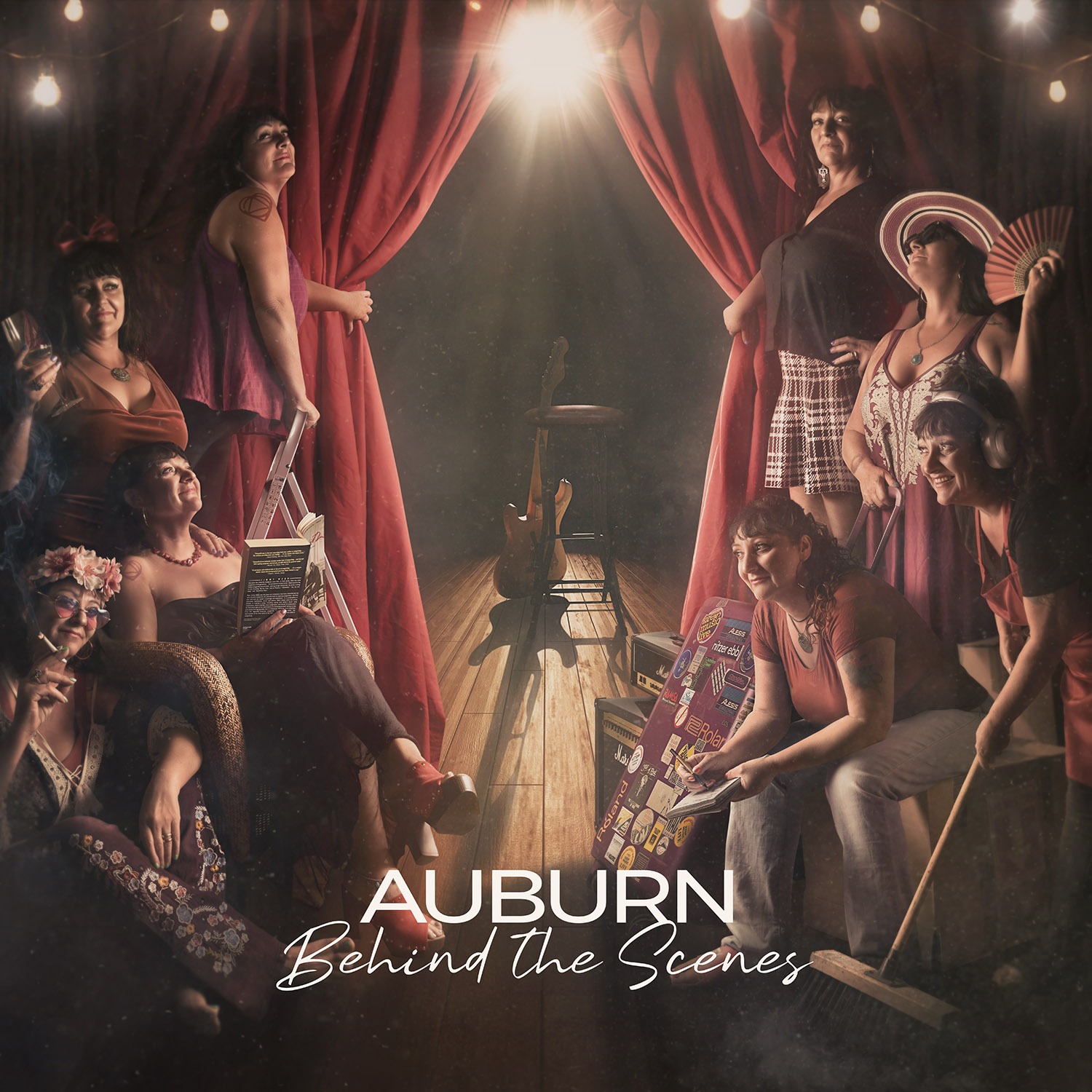
Alan – If we could break down the songs in Behind the Scenes, what would you say about them?
Each song explores a different aspect of connection — whether that’s love, identity, perception, or resilience—and many of them were shaped through collaboration with different writers and musicians.
Bathroom Shelf – A reflective, slightly voyeuristic song about longing and comparison—wanting to step into someone else’s life and love. It’s quite intimate and musically it has a stripped-back feel, produced by Thomm Jutz and Finn Goodwin Bain, with vocal production from Martin Sutton.
Perfect Imperfections – A song about loving someone for exactly who they are. I wrote this with Janet King, Michael Garvin and Sharon Vaughn, up a mountain in Spain and it really celebrates those small, human details that make someone unique.
Let the Good Times Begin – This is really about taking emotional risks and allowing yourself to start again. It features Dante Augustus, who brings a different perspective and energy to the track…and gorgeous bass from the wonderful Mo Pleasure (Earth, wind and fire) and was mixed bu Sie Medway-Smith .
Speaking in Tongues – Is about miscommunication and illusion in relationships. I wrote this with my long-time collaborator Gus (Mark Gustavina), and it also features Eden Ann Parish, whose voice adds another dimension to that sense of dialogue and misunderstanding. I love Thomm and Finns production on this.
Behind the Scenes – The title track looks at identity and perception—what we present to the world versus who we really are underneath. It was written with Gustavo Andriewiski and Dan Ahrens, and I think it really reflects that theme of vulnerability.
What You Don’t Know – An intimate song about the things we hold back, even from those closest to us. This one was very personal, and I also produced it myself, which gave it a slightly different feel. Will Fowlers piano and Pat Garveys drumming – makes the track one of my favourites.
Opposites – A look at relationships and contrast—how differences can actually create balance. Again, this was written with Gustavo Andriewiski and Dan Ahrens, and I loved duetting with Gustavo.
Lie As Easy As You Breathe – One of the darker moments on the album, dealing with deception and betrayal. It’s quite direct lyrically, and musically it leans into that tension.
Don’t Give Up – A message of reassurance and resilience. I wrote this with my nephew, Donovan Lenten, and it’s really about offering support—reminding someone of their strength when they might not feel it themselves.
You’re Beautiful – This song is all about identity and self-worth, shaped by personal journeys and emotional healing. The London Strings performance on this track still brings me to tears.
Sweet Dreams – The albums closing track about love, longing, and connection. It features rapper Sanka GB, who brings a different texture to the track, and it blurs the line between dream and reality. Produced and gorgeous guitars by Thomm Jutz.
Alan – Liz, have you traveled around the world yet? Or not yet. Have you played in Uganda? Or in the Czech Republic or Slovakia?
Liz - I’ve been fortunate to travel and perform across the UK, the US, and parts of Europe, and each place brings something quite distinct—different atmospheres, different ways audiences engage with the music. There are still many places I haven’t played yet, though, and I’d really love to keep exploring. Japan is high on the list, particularly because of its deep respect for artistry and attentive audiences. Canada as well—I think there’s a real openness there, both culturally and musically, that would suit what we do. For me, it’s always about that connection—the way different cultures and audiences respond to the music and shape the experience.
Alan – Speaking of the Czech Republic and Slovakia, do you know these two countries and any artists from these two countries?
Liz - I’m aware of the rich musical traditions in those regions, although I wouldn’t claim deep knowledge of specific artists. It’s always inspiring to discover new music from different cultures, and collaboration often begins with that kind of curiosity. I have spent a lot of time in Greece and love traditional Greek music. I did work on a separate project with some wonderful musicians from Uganda and The Gambia, incorporating kora and traditional percussion. It was a fantastic experience—none of us could really understand each other verbally, but the music connected us completely. It just worked.
Alan – Just by the way, where have you played? And the difference between Europe, the USA, and South America? Brazil?
Liz - Each place has its own character. In the US, I’ve found audiences to be very attentive, especially with the strong storytelling tradition rooted in folk and Americana—they really listen to the songs. Across Europe, there’s often a similar sense of intimacy, with audiences engaging quite closely with the music. In the UK, it can be a bit more varied—sometimes incredibly focused and connected, and other times less so. I haven’t performed in Brazil yet, but I’m really drawn to the musical culture there—the rhythm, the energy, and that deep sense of musicality. It’s definitely somewhere I’d love to experience live.
Alan – Any interesting facts about your playing time? At concerts, festivals? And which festival or concerts are your top? Which do you remember the most and why?
Liz - The most memorable performances are usually the ones where there’s a genuine connection with the audience. It’s less about the size of the venue and more about that shared moment—when people are really present with the music. Gus and I played in New Orleans – and that was incredible – we even went on an alligator hunt! Touring across the UK and Europe with Sophie Ellis-Bextor was an incredible experience, and playing the Hammersmith Apollo on the final night felt genuinely surreal. But equally, our recent album launch in Camden—having a whole room singing along with us—was just as special. That kind of connection and energy is something you never forget.
Alan – When traveling to concerts or festivals, do you have any funny stories? Or directly from playing?
Liz - There are always travel mishaps—missed flights or trains,van breaks down, last-minute changes or unexpected detours. At the time they can feel quite stressful, but they often become the stories you remember most. I remember one night driving across the moors in winter, in complete darkness and thick fog, completely lost. We reached a T-junction and had two sat navs giving completely opposite directions—one said left, the other right. At that point, I just stopped the van and burst into tears. We did eventually find our way to where we were staying—sometime around 3am—but I don’t think I’ve ever been so relieved just to get somewhere!! There are always moments on stage that don’t quite go to plan. I remember a show in Belgium where my outfit had other ideas—my top kept gradually rolling up as I was performing, and there was absolutely nothing I could do about it. At a certain point, you just have to carry on and pretend it’s all intentional. So I did—smiling through it and hoping no one noticed too much. The rest of the band couldnt stop laughing !
Alan – In your opinion, what is the best thing you have achieved?
Liz - I think the most meaningful thing has been creating something that’s lasted—building Auburn into a collaborative project that continues to evolve, while still staying true to what I care about creatively. The fact that people connect with it, and that other musicians want to be part of it, means a lot.
Alan – And what would you like to achieve in your work?
Liz - To keep building on that—growing creatively, reaching new audiences, and continuing to collaborate with musicians from different backgrounds. That sense of exploration is what keeps it exciting. I’m currently promoting Behind the Scenes, with some live shows coming later in the year, which I’m really looking forward to. Performing live is still the best part for me—nothing quite beats that connection with an audience. Writing comes a very close second, and I’m always working on new material and continuing to collaborate with other artists.
Alan – Thanks for the interview. There would be much more, but that would fill up the magazine too much. We'll leave that for another time.
Liz - My pleasure – feel free to edit anything that goes on too long! – thank you for your support x
https://www.auburn.org.uk